
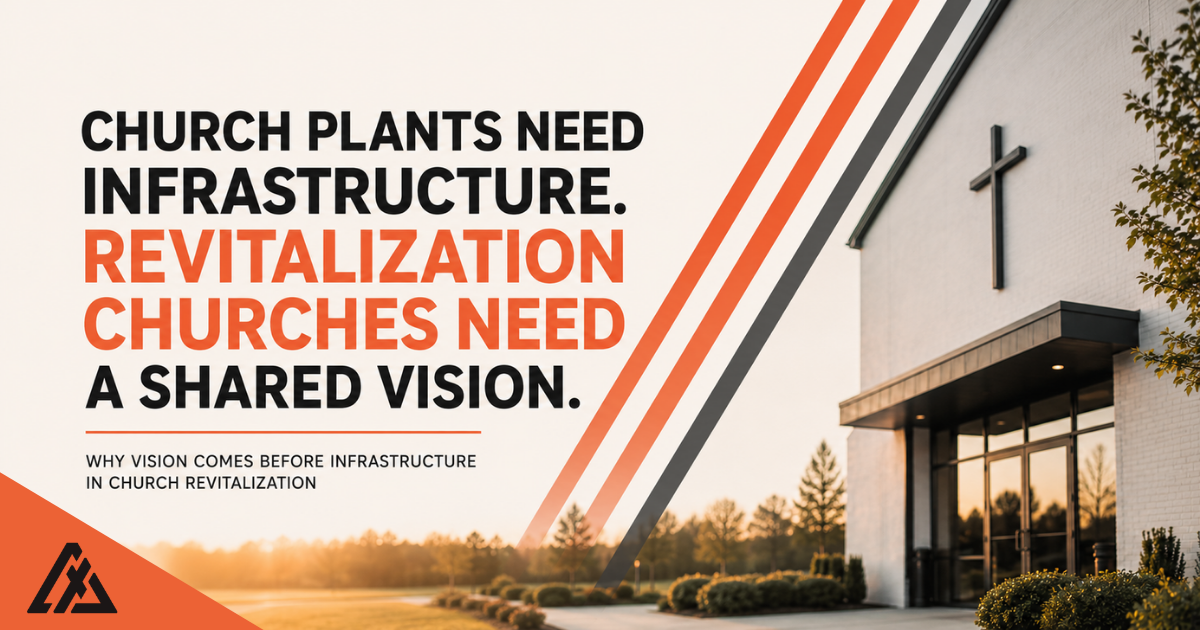
One of the greatest gifts of my ministry journey has been the opportunity to serve in both church revitalization and church planting environments.
For more than twenty years, I served in churches that needed a turnaround. Churches that had experienced years—or even decades—of decline and were searching for a healthier future.
Then, several years ago, I stepped into a senior leadership role as Executive Pastor at a fast-growing church plant.
Both experiences were rewarding.
Both were challenging.
Both required faith, leadership, perseverance, and a deep dependence on God.
But one of the biggest lessons I learned from serving in both worlds is this:
Church plants and revitalization churches are often solving very different problems.
The longer I served in a growing church plant, the more I realized that many revitalization pastors are carrying challenges that church planters rarely have to face.
And it all begins with a fundamental difference.
Church plants start with a shared vision and eventually need infrastructure. Revitalization churches often need to rediscover a shared vision before they can fully leverage the infrastructure they already have.
Same Size. Different Church.
Imagine two churches.
Both average 200 people on a Sunday.
Both have similar budgets.
Both have a similar number of volunteers.
On paper, they look almost identical.
But beneath the surface, they may be operating in completely different realities.
The church plant is growing.
New people are showing up.
Leaders are emerging.
Momentum is building.
The conversations center around questions like:
Do we need another service?
How do we develop more leaders?
How do we onboard more volunteers?
How do we build systems that can keep up with growth?
How do we create enough space for what's coming next?
Those are infrastructure questions.
Now consider the revitalization church.
The conversations often sound very different:
1. Where is God calling us in the next three to five years?
2. Who has God uniquely positioned us to reach?
3. What ministries should we prioritize?
4. What should stay?
5. What should change?
6. How do we move forward together?
Those aren't infrastructure questions.
Those are vision and alignment questions.
The Hidden Advantage of Church Plants
Imagine two churches.
Both average 200 people on a Sunday.
Both have similar budgets.
Both have a similar number of volunteers.
On paper, they look almost identical.
But beneath the surface, they may be operating in completely different realities.
The church plant is growing.
New people are showing up.
Leaders are emerging.
Momentum is building.
The conversations center around questions like:
Do we need another service?
How do we develop more leaders?
How do we onboard more volunteers?
How do we build systems that can keep up with growth?
How do we create enough space for what's coming next?
Those are infrastructure questions.
Now consider the revitalization church.
The conversations often sound very different:
1. Where is God calling us in the next three to five years?
2. Who has God uniquely positioned us to reach?
3. What ministries should we prioritize?
4. What should stay?
5. What should change?
6. How do we move forward together?
Those aren't infrastructure questions.
Those are vision and alignment questions.
The Hidden Challenge of Revitalization
Now compare that to a revitalization church.
People didn't join the church last month.
Some joined 30 years ago.
Some joined under a previous pastor.
Some joined when the church had a different mission emphasis.
Some joined when it was twice the size.
Some joined because of the music.
Some because of the children's ministry.
Some because of family history.
Some because of theology.
The result is often:
Multiple groups carrying multiple visions of what the church should become.
That's a very different leadership challenge.
The challenge isn't necessarily a lack of passion.
The challenge is a lack of shared direction.
The pastor isn't simply leading people toward a destination.
He's helping people agree on the destination.
Many revitalization churches are filled with good people who genuinely love their church.
They just aren't all moving toward the same future.
And when that happens, activity increases but momentum doesn't.
The calendar fills up.
Programs continue.
Meetings happen.
Yet the church struggles to move forward because people are pulling in different directions.
Why Vision Must Come Before Infrastructure
One of the biggest mistakes I've made—and one I see many churches make—is attempting to solve alignment problems with infrastructure solutions.
A church feels stuck.
Attendance plateaus.
Momentum slows.
Volunteer engagement declines.
The immediate assumption is often:
- "We need a renovation."
- "We need more staff."
- "We need another ministry."
- "We need a new discipleship program."
- "We need to change the music."
Sometimes those things are necessary.
But often they are not the real issue.
The real issue is that the church lacks a shared picture of the future.
Infrastructure supports clarity.
It rarely creates it.
An updated lobby cannot solve a vision problem.
A new ministry cannot solve an alignment problem.
Additional staff cannot create a shared future.
A Collaborative Process for Rediscovering the Future
This is why I believe revitalization requires something many church plants naturally experience before launch.
It requires a collaborative process for dreaming again.
Not a committee.
Not endless meetings.
Not a democratic vote on the future.
A process that helps leaders and congregations prayerfully discern God's desired future for their church.
A process that creates clarity.
A process that builds ownership.
A process that aligns people, priorities, ministries, and resources around a shared mission.
Because once a church gains clarity around its future, everything else becomes easier to evaluate.
Programs can be measured against the vision.
Budgets can be aligned with the mission.
Staffing can support strategic priorities.
Resources can be directed toward what matters most.
The church begins moving together instead of merely staying busy.
A Better Way Forward
Church plants and revitalization churches both need vision.
Both need leadership.
Both need healthy systems.
Both eventually need infrastructure.
But they don't need those things in the same order.
Church plants often begin with vision and alignment and eventually require infrastructure.
Revitalization churches often need to rediscover vision and alignment so they can redesign their existing infrastructure around where God is calling them next.
That's why some of the most important work in church revitalization isn't found in buildings, budgets, or organizational charts.
It's found in helping a church answer six simple but powerful questions:
1. Where is God calling us in the next three to five years?
2. Who has God uniquely positioned us to reach?
3. What is our current reality?
4. What must change?
5. What must stay?
6. How do we move forward together?
Because when a church discovers a shared future, alignment follows.
And when alignment follows, momentum becomes possible again.
What’s Next?
If this framework is true, it raises an important question:
Why do so many churches attempt to solve alignment problems with infrastructure solutions?
Why do churches launch new programs, hire new staff, renovate facilities, or even build new buildings when the deeper issue is often a lack of shared vision?
In the next article, we'll explore why churches frequently choose expensive solutions over uncomfortable ones—and how leaders can diagnose whether they're facing an infrastructure problem or an alignment problem.
And if your church is struggling to answer questions like:
• Where is God calling us in the next 3–5 years?
• Who has God uniquely positioned us to reach?
• How do we align our people, ministries, and resources around that vision?
I'd love to hear your story. Send me a DM and tell me about your church, your challenges, and what you're sensing God may be doing next.
You k5our stor. What how do you think we shold develop a shared vision?
I believe it requires in-depth spiritual preparation (prayer, fasting, transforming our minds) followed by a Spirit-led collaborative process among key leaders. That process involves dreaming together about the next chapter God wants to write in the story of our church + having honest conversations about our current reality + having the courage to take the steps necessary to move from our current reality to God’s desired future. That is a process I have been refining over the last several years by reflecting on the successes and failures I havre experienced in leading church revitalization.